
How Are Ceramic Coatings Tested for Quality?
You wouldn’t buy a car without checking its safety rating, right? So why would you slap a ceramic coating on your pride and joy without knowing if it can stand up to the elements?
These coatings for cars are a serious investment, promising to protect your paint from everything Mother Nature and the open road can throw at it. But not all coatings are created equal.
So, how do you separate the real deal from the snake oil? It all comes down to rigorous, standardized testing.
Before a quality ceramic coating ever touches your vehicle, it goes through a battery of tests designed to push it to its limits. At least, they are supposed to.
This article is our second in a three-part series that will pull back the curtain on the science behind ceramic coating quality control, explaining the key properties that are tested and the methods used to ensure you’re getting the protection you paid for.
Icon Rocklear Virginia provided a nice range of options. I particularly like the warranty and “fixability” of Icon Rocklear (used on the paint).The rest of the car was ceramic coated. Head to toe treatment. My car is six years old and it looks brand new. Very happy. I just use a foam cannon, rinse it off, and it sparkles! Because the car has “no substitute.”
Understanding the Key Properties Tested
A good ceramic coating has to do more than look shiny. It needs to form a durable, protective layer that can withstand harsh conditions. To ensure a product delivers on its promises, manufacturers test for several key properties:
- Corrosion Resistance: How well does the coating protect the metal underneath from rust and corrosion, especially from road salt and acidic rain?
- UV Protection: Can the coating prevent the sun’s ultraviolet rays from fading and oxidizing your car’s paint?
- Scratch Resistance: How tough is the surface? Can it resist minor scratches and swirl marks from daily driving and washing?
- Hydrophobicity: Does the coating repel water effectively, causing it to bead up and roll off, taking dirt and grime with it?
Each of these properties is crucial for the overall performance and longevity of the coating. Now, let’s look at the specific tests used to measure them.
Overview of Coating Testing Methods
To get objective, repeatable results, the industry relies on standardized testing methods. Organizations like ASTM International (American Society for Testing and Materials) develop and publish these standards, ensuring that when a product claims a certain level of performance, it’s been verified through a consistent and reliable process.
Here are the four most common tests you’ll see used to validate the quality of a professional-grade ceramic coating.

Salt Spray Testing: Assessing Corrosion Resistance
Your car is constantly under attack from corrosive elements, with road salt in winter being one of the worst offenders. To simulate this harsh environment, manufacturers use a salt spray test, often following the ASTM B117 standard.
How it works: A coated metal panel is placed inside a sealed chamber. A saltwater solution is then atomized into a dense fog, completely enveloping the panel. This chamber maintains a constant temperature and humidity, creating an accelerated corrosive environment. The test can run for hundreds, or even thousands, of hours.
What they look for: Technicians periodically inspect the panel for any signs of corrosion, such as rust, blistering, or peeling of the coating. The longer the coating can withstand the salt spray without failing, the better its corrosion resistance.
A top-tier coating will show minimal to no signs of degradation even after an extended period, proving it can protect your car’s body from the long-term damage caused by salt and moisture.
QUV Testing: Evaluating UV Protection
The sun’s UV rays are relentless. Over time, they break down your car’s clear coat and paint, leading to fading, chalking, and oxidation. A quality ceramic coating acts like a layer of industrial-strength sunscreen for your car. To test its effectiveness, labs use a QUV Accelerated Weathering Tester.
How it works: The QUV test (ASTM G154) exposes coated panels to alternating cycles of intense UV light and moisture. Fluorescent lamps simulate the damaging portion of the solar spectrum, while a condensation system mimics dew and rain. This process rapidly ages the coating, replicating months or even years of outdoor exposure in just a few weeks.
What they look for: During and after the test, the panels are checked for color changes (fading), gloss level, and physical integrity (cracking or chalking). A superior ceramic coating will maintain its original appearance and protective properties, demonstrating its ability to keep your car’s paint looking vibrant and new for years to come.
Pencil Hardness Testing: Measuring Scratch Resistance
While no ceramic coating can make your car bulletproof, a good one should offer significant resistance to light scratches and swirl marks from car washes or daily wear and tear. The industry-standard method for measuring this is the Pencil Hardness Test (ASTM D3363).
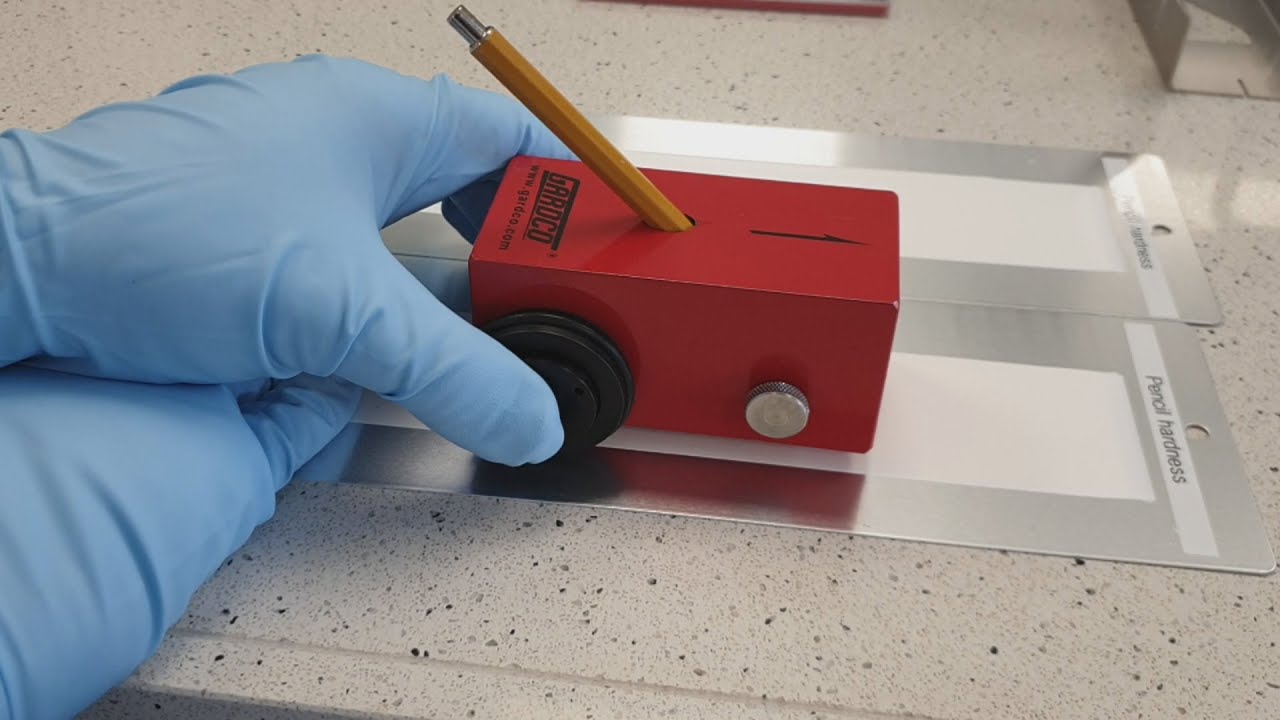
How it works: It might sound simple, but this test is surprisingly precise. It uses a set of calibrated graphite pencils of varying hardness, ranging from a soft 6B to a very hard 9H. A technician presses a pencil at a 45-degree angle onto the coated surface and pushes it forward. The process starts with softer pencils and moves up the hardness scale.
What they look for: The “pencil hardness” of the coating is defined by the hardest pencil that fails to scratch the surface. For example, if a 7H pencil leaves a mark but a 6H doesn’t, the coating has a hardness of 6H.
While many brands boast a “9H” or “10H” rating, it’s important to remember this test measures scratch resistance, not overall durability. Still, a higher rating indicates a more rigid surface that is better equipped to handle minor abrasions.
Water Contact Angle Testing: Checking Hydrophobic Properties
One of the most satisfying benefits of a ceramic coating is seeing water bead up and fly off your car. This “hydrophobic” effect isn’t just for show—it helps keep your car cleaner by preventing water spots and carrying away dirt. This property is measured using a Water Contact Angle test.
How it works: A goniometer, a specialized optical instrument, places a precise droplet of water onto the coated surface. A camera then captures the profile of the droplet, and software measures the angle formed between the surface of the coating and the edge of the water droplet.
What they look for: A higher contact angle means greater hydrophobicity. An uncoated surface might have a contact angle of around 70-80 degrees. A quality ceramic coating, however, will have a contact angle well over 100 degrees, sometimes reaching 110-120 degrees.
This high angle indicates that the surface has low surface energy, forcing water to form tight, round beads that roll off easily instead of clinging to the paint.
Why Quality Testing Is Not Negotiable
When you choose a ceramic coating, you’re not just buying a bottle of liquid; you’re investing in a promise of long-term protection. Rigorous, standardized testing is the only way to verify that a product can live up to that promise. These tests provide objective data on a coating’s ability to resist corrosion, UV damage, scratches, and water.
Without this proof, you’re just taking a manufacturer’s word for it. By understanding how quality coatings are tested, you can ask the right questions and choose a product that has been proven to perform, ensuring your investment is protected and your vehicle looks its best for the long haul.
But proof of concept and accelerated data will never replace time and real-world testing. An advanced paint protection coating like Icon Rocklear has been tested in both laboratory and real-world environments for more than a decade.
With each test or version of our coating, we’ve learned from mistakes, discovered the root issue, and have placed controls to ensure we’re constantly moving forward with better solutions.
As we wrap up this blog series, we’ll focus on how Icon Rocklear takes the normal testing process for ceramic coatings and kicks it up quite a bit.